Curriculum Statement
Intent
- develop faith in God, and faith in themselves as beings created to be knowledgeable, wise, and creative in His image
- develop love for God and people. They will develop knowledge and skills so that they are equipped to lead through service and play a positive role within their local and the global community
- develop excellence in knowledge and skills. They will develop as critical and curious thinkers, who are articulate in communicating their ideas.
We have an ambitious curriculum, which aims to equip pupils with the knowledge and skills that will:
- enable pupils to build strong foundations of knowledge upon which they can firmly anchor new knowledge and make connections throughout the rest of the lives
- prepare pupils to be highly successful in an academic and aspirational education
- encourage and maintain our pupils’ curiosity by making learning purposeful
- encourage pupils to lead happy and healthy lives throughout childhood and into adulthood
- ensure that all pupils’ leave The Light Christian School being able to read well and have a love reading
- inspire children to be inquisitive and believe that they can achieve anything they put their mind to
- create learners that have a love for learning and embody our core values

We deliver an ambitious curriculum that intentionally exceeds national standards. Our framework is characterised by its breadth and depth, utilising a spiraled structure where key concepts are systematically revisited to secure foundational knowledge and build cultural capital. This meticulous design bridges the gap between discrete “component knowledge” and complex “composite goals,” ensuring a coherent learning journey that leads to academic outcomes consistently above national benchmarks.
In our English curriculum, we combine a rigorous mastery approach with high-quality children’s literature to drive successful writing outcomes across our mixed-age classrooms.
We utilise a two-year rolling cycle that rotates core texts across paired year groups, ensuring that no child ever repeats a book. This framework allows us to create a powerful shared text experience where the entire class reads, investigates, and builds rich vocabulary around the exact same book. To balance varying age expectations, our dual-objective planning is physically laid out to display lower year-group writing objectives on the left side and higher year-group objectives on the right.

This layout flows naturally into differentiated application during independent work; for example, while we might bring the whole class together to build vocabulary for a setting description, we split the independent execution. We will guide the younger year group through a specific grammatical mechanic (like using ‘a’ vs ‘an’), while our older pupils independently draft extended paragraphs focusing on higher-level vocabulary choices.

To teach mathematics effectively without separating our mixed-age classes for every topic, we track common mathematical themes simultaneously.
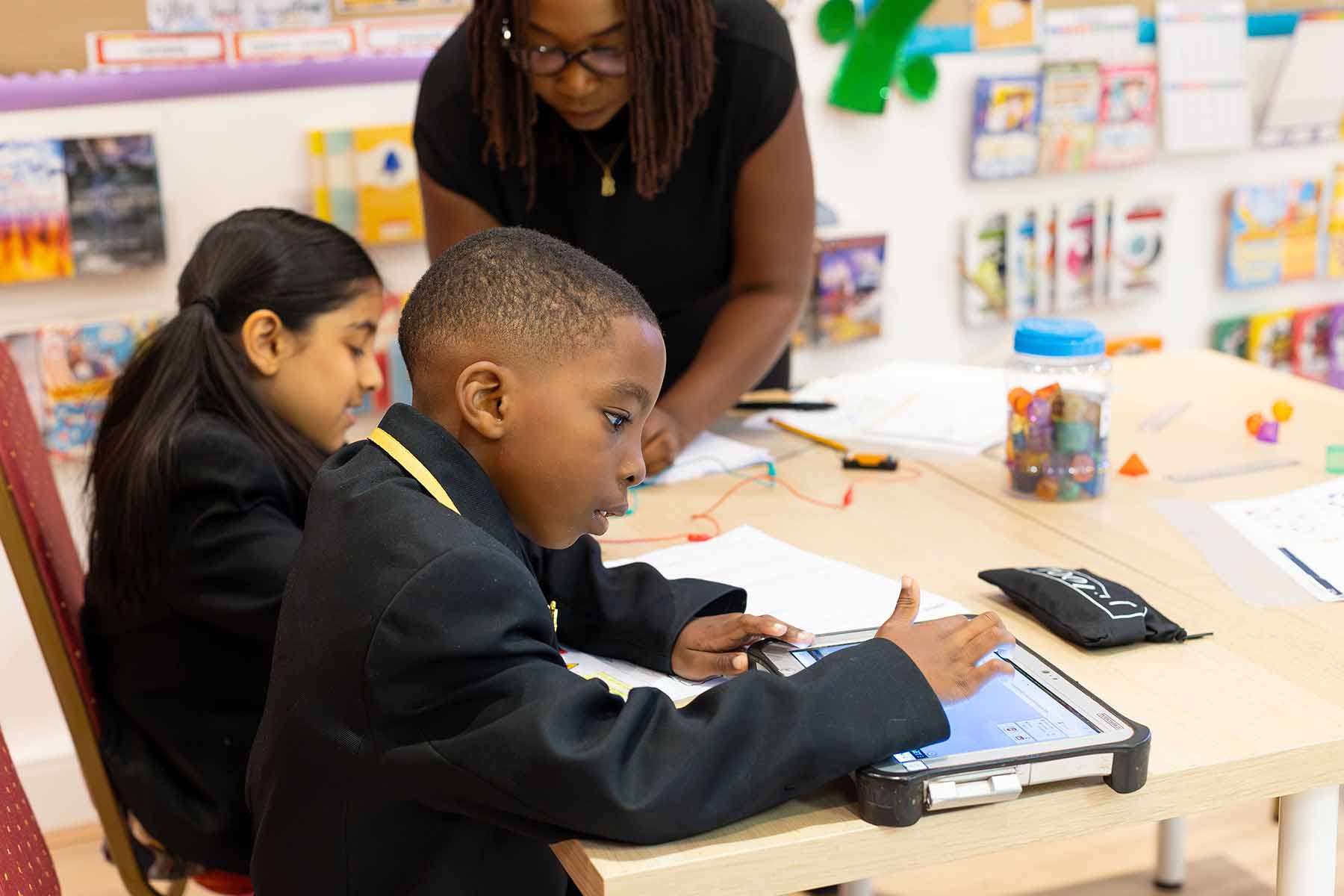
Through merged blocks of learning, we align our curriculum so that both year groups study the same overarching concept at the same time, such as tackling Place Value or Addition and Subtraction together. Every lesson begins with a whole-class shared input, where we deliver a single, cohesive introduction using carefully structured conceptual models. To facilitate this visually, we utilize interactive split-screen slides: the left side displays the age-related question or representation for the lower year group, while the right side shows the corresponding step for the higher year group. Following this shared input, we guide students through differentiated small steps, where they complete separate, tailored worksheets aligned with their specific year-group expectations as they move from concrete to abstract tracking.
For Science and our foundation subjects - including Art, DT, History, and Geography - we utilise Kapow Primary’s structured two-year rolling cycle, split into Cycle A and Cycle B.
Instead of separating year groups, we keep our mixed-age classes together to study the exact same whole-class topics at the same time. During Cycle A (Year 1 of the cycle), all children study one specific set of units, and we transition to an entirely different set of units for Cycle B the following year. This alternating content prevents our younger children from repeating the same material when they progress to the next year group. Crucially, our model relies on a spiral progression, meaning we intentionally revisit key skills and vocabulary each year. We use differentiated lesson plans to assess and stretch our older or higher-ability pupils while keeping the entire class rooted in the same foundational lesson.
We prioritise consistency through research-informed practice. Teachers utilise adapted resources and adaptive teaching practices to ensure the curriculum is accessible to all, including pupils with SEND. By maintaining clear learning objectives and success criteria, we create a transparent roadmap for achievement.


From Nursery, phonics is delivered with systematic precision. This includes scaffolding, pre-teaching vocabulary, and language-rich environments.
In the Early Years, storytelling served as our primary pedagogical vehicle for oracy, immersing children in diverse narratives to build the confidence and articulation required for future success.
As pupils transition into Key Stage 2, the curriculum evolves to address contemporary global challenges such as climate change and social justice. Through critical inquiry, pupils engage with representative texts and diverse voices, ensuring their education is not only academically rigorous but also socially purposeful and relevant to the modern world.
The Curriculum
Preschool
In our Nursery and Reception classes, we follow the Early Years Foundation Stage (EYFS) Statutory Framework. Our practice is shaped by four fundamental principles:
- A unique child: Every child is a unique and competent learner from birth, taking an active role in their learning.
- Positive relationships: Children learn to be strong and independent through loving and secure relationships.
- Enabling environments: A well-designed environment responds to individual needs and encourages confident exploration.
- Learning and development: All areas of learning are equally important and interconnected, with children developing at their own pace.
Our curriculum facilitates discovery across seven areas of learning:
- Prime Areas: Communication and Language; Personal, Social and Emotional Development; and Physical Development. These form the crucial foundations for learning and relationships.
- Specific Areas: Literacy, Mathematics, Understanding the World, and Expressive Arts and Design. These provide a broad curriculum to educate the whole child.
The EYFS is the very beginning of an exciting and extensive learning journey for our students where we facilitate a broad range of opportunities for them to experience and discover the world around them through the educational programmes across the seven areas of development. It is in these years that we will nurture our students to develop effective characteristics of learning that will begin the foundations of lifelong skills as well as ignite student’s curiosity and enthusiasm for learning. This is detailed further in the EYFS Curriculum Plan and accompanying Scheme of Work.

Our curriculum is structured around the Trivium. We apply the Trivium to our instructional methodology and academic development. The phases of the Trivium are grammar, logic, and rhetoric. Grammar refers to the building blocks of each subject, the basic facts, and truths. Logic offers a disciplined experience of things, teaching students how to think, not what to think. Rhetoric focuses on training students to express what they have learned clearly and winsomely.
The phases of grammar, logic, and rhetoric correlate with and complement the phases of child development. We teach and design our lessons to fit the way God has made students at each age and stage. Primary school children in the grammar stage enjoy games, stories, songs, and repetitious word sounds. Our teaching methods include lots of chanting, reciting, singing, hands-on projects, drills, and games. Middle school coincides with logic, and at this age, children want to argue and challenge and ask “why?” We introduce formal logic and give them opportunities and tools to evaluate, critique, debate, persuade, and present. By high school, students have learned vast amounts of knowledge and desire to express their feelings and ideas. This is the time for teaching rhetoric, the art of presenting ideas, taking what one has learned and expressing it outwardly.
Grammar Stage
The Grammar Stage consists of Year One to Year Six classes (ages 5-11). We utilise a knowledge-rich curriculum specifically designed for mixed-age classes, which ensures rigorous progression and academic mastery. The subjects within the curriculum are:
- English (we will sometimes refer to it as Language and Literature),
- Mathematics,
- Science,
- History,
- Geography,
- Religious Education,
- Art,
- Physical Education,
- Information Technology,
- PSHE including Citizenship,
These are detailed further in the Year One to Year Six Curriculum Plans and accompanying Schemes of Work.

Organisation and Planning
We take great care to plan our curriculum carefully so that there is coherence and progression at every stage. We employ a knowledge-rich curriculum tailored for mixed-age classes, emphasizing daily retrieval and academic mastery as core instructional methodologies. These plans are reviewed annually to promote best practice and ensure they meet the specific needs of our current cohorts.
We are reviewing our long-term plans on an annual basis. Maths and English are taught every morning. Afternoon sessions (from Year One onwards) will, as described above, typically involve enrichment subjects. This covers a wide range of subjects to offer a broad and balanced curriculum and help students grasp concepts in an engaging way.
We recognise that classes consist of students with a range of different needs, skills, and personalities and, in order to teach effectively and for all pupils to make good progress, class teachers must take this into account. Therefore, our plans and schemes of work for each year group work to provide a benchmark for age-related expectations but it is within the role and responsibilities of class teachers to adapt their planning and teaching to meet the needs of all pupils through avenues such as adaptive teaching, responsive teaching/formative assessment, adjusted levels of adult involvement/support and challenge to stretch, etc. Assessments should actively inform class teachers’ planning in this regard.
At The Light Christian School we believe that accurate assessment is the basis of high-quality teaching. Assessment is now clearly linked to units of learning, utilising pedagogical approaches like “hinge questions” to check understanding as it takes place. This allows teaching and learning to be planned and delivered appropriately so that all students are supported and stretched to reach their very best potential.
At the end of Reception, EYFS profiles, produced in line with statutory requirements, are completed which provide a basis upon which Year One teachers can build. These profiles are produced in accordance with the guidance we have included in our EYFS Curriculum Plan.
In the Grammar stage, assessment will be carried out in line with our Assessment Procedure Policy. Progress in subjects will be assessed as an ongoing practice and will be formally assessed at the end of each year. Each subject will be included in reports given to parents twice a year.
Evaluation is essential for the planning and development of the curriculum. The senior leadership team is responsible for the overall school curriculum. They monitor planning, are part of “Work Scrutinies” and moderations, lead pupil performance reviews, and carry out regular learning walks in order to support teachers as they deliver their plans and develop their knowledge and expertise.
The school governors place the quality of teaching at the very top of its list of priorities and it will actively and formally review the curriculum, its delivery and its effectiveness at least annually.
The Light Christian School
Why do we do
what we do?

We want our children to have a strong sense of belonging
As a small independent school, we are able to foster a real sense of community that enables every single member of our school community to have a sense of belonging whether you are a child, a parent or a staff member. We cherish the unity of belonging to our Light School family whilst also celebrating the diversity that our family is made up of. Our small setting means that we can operate as a ‘family’ and as all adults in school know the children extremely well, it means that we can adapt our provision to meet their specific needs.
We want our children to be confident
At its heart, our curriculum aims to foster and develop children who are confident. We want them to be confident in their identity and in their abilities as resilient learners; interested in the world around them, and able to question the things that they see; articulate and able to engage with topics with maturity; well-rounded, in that they have been exposed and introduced to a curriculum that has breadth and depth and can make links and connections with the world around them. It is our belief that confident pupils require a knowledge rich curriculum. For us at The Light Christian School this starts with reading as it unlocks the rest of the curriculum for all our children. We know that reading is a key life skill. From the first day here at The Light Christian School, we are building the foundations for pupils not only to learn to read but to love to read throughout school and beyond.


We want our children to be aspirational and driven
We want our children to be enthusiastic learners with a real love for learning. Our curriculum inspires children to be inquisitive and curious. Our curriculum must allow children to develop as leaders. Because of this, our curriculum places an unapologetic emphasis on the importance of ensuring that our children are confidently literate and numerate, as these skills underpin all learning. We want all of our children to be aspirational and driven to believe in themselves so that they can achieve anything they put their mind to.
We want our children to be kind and collaborative
Our children are taught of the ‘fruits of the spirit’ and the importance of them being kind, considerate and empathetic individuals. Spiritual, moral, and cultural education is taught explicitly throughout our curriculum and assemblies but also implicitly in the way that staff model positive relationships, patience, kindness, and conflict management. The children are immersed in several opportunities to show kind and collaborative behaviours. This is also emphasised in our behaviour system that praises positive choices and encourages restorative conversations.


We want our children to be independent
We foster in all our children an intrinsic love of learning which is developed through a range of techniques – open ended tasks, peer mentoring, classrooms set up to encourage independence and problem-solving activities. We want our children to be independent thinkers which is encouraged through our lessons, assemblies, class debates and PSHE lessons. We want our children to have a strong Christian moral grounding which governs all their decision making. There is a focus on enriching and using vocabulary accurately in all subjects which enables a better understanding of concepts, ideas and supports the children in being able to articulate clearly what they have learnt in each subject. We do this by expanding their cultural capital and the breadth of their vocabulary.
We want our children to embrace challenges and obstacles
At The Light Christian School we teach a mastery curriculum which means that the children are constantly working to develop their knowledge, skills and understanding rather than achieving certain criteria. We have a shared acknowledgment that being able to fail is vital to children’s success later in life. Having an understanding that failure is a learning process enables our children to take ownership of their learning and embrace failure with a growth mindset. Our curriculum shares with our children, content and opportunities that take them beyond their daily immediate surroundings and offers them experiences across a wealth of different subjects, developing talents and igniting their own individual interests. We want all our children to be resilient so that they are prepared for every changing world we live in and have the self-belief that they can achieve anything.
It is important that our curriculum for Key Stage 1 builds on the child-initiated ethos of the Early Years Foundation Stage principles. Pupils should be active partners in developing the curriculum. Their questions, interests and ideas are therefore utilised to develop and enhance planned learning experiences.

Subscribe today and stay up to date
+
Join the community